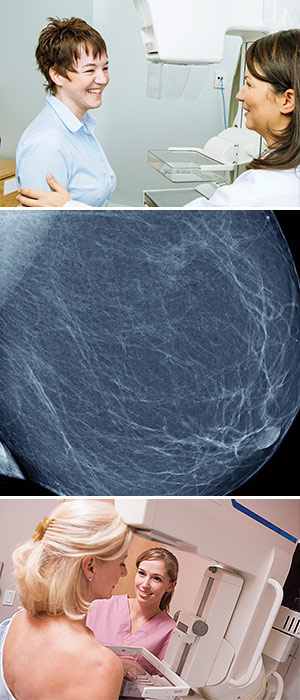
Mammography is the imaging of the human breast for the purpose of detecting malignant tissue growth and (micro-) calcifications. Currently there are several modalities in both 2D and 3D X-ray imaging that are approved for clinical use.
Explore Teledyne DALSA Mammography TechnologyScreening mammography is a 2D X-ray modality used for regular health checks for early indications of possible breast cancer developments.
Another 2D X-ray modality, diagnostic mammography is used for detailed investigation of already identified suspicion of developed breast cancer. It requires higher resolution and better image quality than screening.
An emerging 2D modality in X-ray mammography is Contrast Enhanced Mammography, which uses alternation of X-ray tube voltages to acquire multiple exposures of images during the same examination for significantly improved diagnostic information on breast cancer development.
An emerging 3D X-ray diagnostic modality is DBT (Digital Breast Tomosynthesis), which produces pseudo-3D (high resolution in X-Y directions and usually 0.5 mm to 1 mm step in Z direction) volume model of the breast structure. There are multiple research results confirming significantly higher information content available from DBT, especially for dense breast patients. DBT shows very solid promise for displacing 2D X-Ray as the de-facto standard diagnostic procedure for breast cancer screening in the near future.
3D DBT mammography examinations are usually conducted using elevated X-ray energy, which reduces the efficiency of X-ray detectors optimized for 2D imaging; this means an inevitable compromise in performance is needed for systems intended for both 2D and 3D X-ray mammography. The current trend in detector performance is to focus on DBT image quality as 2D images can be reconstructed from a 3D DBT image.
CR (computed radiography) flat solid-state detectors have been the dominant type of digital X-ray detectors on the market. However, CR technology (storage screens with optical readout in a dedicated scanner) does not deliver the same level of performance as existing flat panel technology and has elaborate workflow, especially unfavorable for screening. Therefore it is being phased out of X-ray mammography applications.
In most cases commercial mammography detectors use specialized TFT (thin-film transistor) panels made of amorphous silicon (a-Si) to read out signals captured with either a layer of scintillator conversion material such as cesium iodide (CsI) or a layer of direct x-ray detection material such as amorphous selenium (a-Se). The maximum resolution of those flat panels is limited to approximately 7 line pairs per millimeter (lp/mm), which is significantly lower than what was achieved by screen-film image capture. The existing technology of TFT panels does not allow for further decrease in pixel sizes without severely compromising the performance and/or costs of the products. Existing TFT technology also struggles to deliver the speed and image quality necessary for new modalities: temporal artifacts of TFT along with high non-linearity of the photoconductors are significant roadblocks.
CMOS flat detectors offer a new way to capture the signals from scintillator conversions. With the significant advantages of much lower noise, much lower power consumption, and much higher resolution and speed, Teledyne DALSA's CMOS technology delivers all the right answers to the imaging challenges X-ray mammography brings now and in the future. Teledyne DALSA's Xineos-2329 detector delivers best in class image quality and fully supports both the dynamic image acquisition mode required for emerging advanced modalities, as well as "traditional" 2D imaging. Teledyne DALSA CMOS X-ray detector technology overcomes the limitations of incumbent products and allows OEMs to offer system solutions with improved patient comfort and significantly increased quality of medical care.
The Xineos-2329 detector is designed to outperform all existing detectors in all clinically approved 2D and 3D X-ray mammography applications in a single detector. The chart below highlights the advantages of Teledyne DALSA's CMOS mammography X-ray detector over other technologies used in the industry.
The Xineos-2329 is built using Teledyne DALSA's latest (6th generation) CMOS process optimized for X-ray imaging applications and radiation hardness. This latest generation delivers the breakthrough noise performance that enables OEMs to achieve the next levels in image quality.

The chart below presents the DQE vs. dose performance of the Xineos-2329. For the multiple images required by the DBT modality, it is critical for the mammography detector to maintain high DQE at very low doses per image. No other commercially available detector in the industry is capable of demonstrating this high DQE down to such low fluxes of counted X-ray photons per frame.

Xineos-2329 also features a number of patent pending advancements in detector architecture which allow for the smallest detector form-factor in the industry--which allow the detector to be retrofitted into X-ray film and CR based X-ray systems.
Ask us about mammography